
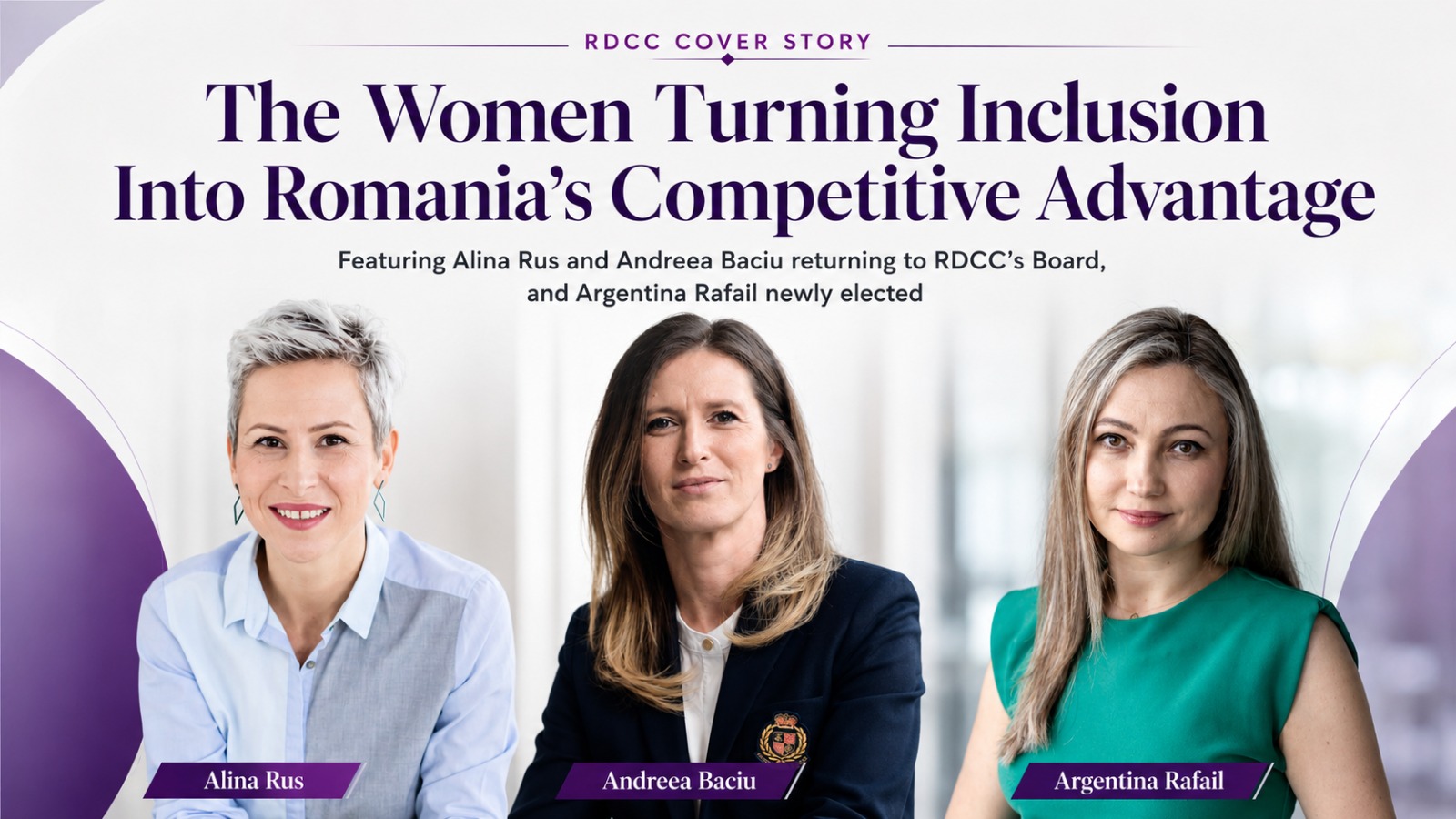
The Women Turning Inclusion Into Romania’s Competitive Advantage
With Alina Rus and Andreea Baciu returning to RDCC’s Board, and Argentina Rafail newly elected, three women from finance, technology, culture, and law are helping shape the next chapter of inclusive business leadership in Romania.
There are moments when leadership is not defined by a title, but by the kind of future a person is willing to help build.
For the Romanian Diversity Chamber of Commerce, this is one of those moments.
As RDCC enters a new Board mandate, three women stand at the center of a larger story about Romania’s business future: Alina Rus, Chief Financial Officer of Raiffeisen Bank Romania and returning RDCC Treasurer; Andreea Baciu, Chief Culture Officer at UiPath and returning RDCC Board Member; and Argentina Rafail, Co-Head of the Employment and Labor Practice at Dentons Bucharest and newly elected RDCC Board Member.
Their professional worlds may look different at first glance. One leads through financial governance. One through culture, belonging, and leadership in the age of AI. One through law, compliance, accessibility, and workplace fairness.
But together, they represent a powerful idea: inclusion is no longer a side conversation in business. It is becoming a core discipline of competitiveness.
At a time when companies across Europe are being asked to rethink how they hire, lead, innovate, comply, and grow, RDCC’s renewed Board leadership signals something important for Romania. The future of business will not be built only by those who move fastest. It will be built by those who understand people best.
A Board Mandate Rooted In Action, Not Optics
RDCC’s mission has always gone beyond representation. It is about inclusive economic growth, fairer workplaces, stronger corporate cultures, and business strategies that can withstand the pressures of a changing world.
That mission now meets a business environment shaped by overlapping forces: new European compliance expectations, rising demands for accessibility, the acceleration of AI, generational change, labor-market transformation, and a sharper public expectation that companies should not only perform well, but behave responsibly.
For Alina Rus, returning to the Board as RDCC Treasurer, this is where governance matters.
As CFO of Raiffeisen Bank Romania, she brings a perspective often missing from conversations about inclusion: the understanding that meaningful change requires structure, investment, accountability, and resources. Her previous Board service strengthened her commitment to RDCC’s mission, and her new mandate focuses on using strategic planning, financial oversight, community engagement, and professional networks to help RDCC scale its impact.
“Inclusion becomes meaningful when it is supported by responsibility, resources, and long-term commitment. For me, returning to the RDCC Board means continuing to help transform good intentions into initiatives that create measurable value for communities, companies, and society.” – Alina Rus
The Culture Question In The Age Of AI
If Alina brings the discipline of governance, Andreea Baciu brings the urgency of culture.
As Chief Culture Officer at UiPath, a Romanian-born global technology company operating at the forefront of automation and AI transformation, Andreea’s work sits at the intersection of leadership, belonging, digital transformation, and human behavior.
Her return to the RDCC Board comes at a defining moment. AI is changing jobs, workflows, skills, and decision-making. But beneath every technological shift lies a deeply human question: who benefits, who is included, and who gets left behind?
Andreea’s perspective is clear: inclusive leadership is not only a values-driven agenda. It is a business imperative connected to performance, innovation, and resilience. In her Board application, she links her renewed mandate to the need to actively shape inclusive behavior in a complex society marked by digitalization, AI, and polarization.
“Belonging is not a soft concept. It is the foundation that allows people to contribute, challenge, innovate, and grow. In a world shaped by AI and constant transformation, inclusive leadership becomes one of the most important capabilities organizations can build.” – Andreea Baciu
The language is consistent with her earlier RDCC interview, where she said UiPath wanted to focus on creating a workplace culture where people feel they belong, calling belonging a key aspect of diversity and inclusion that is not addressed often enough.
That idea is especially relevant for Romania. As the country positions itself within European and global markets, competitiveness will increasingly depend on whether organizations can build cultures where people feel safe to contribute, question assumptions, learn new skills, and adapt.
Inclusion, in this context, is not about avoiding discomfort. It is about creating the conditions for better decisions.
It is also about courage. Andreea sees RDCC as a platform for honest, sometimes difficult conversations — the kind that move companies beyond polished statements and toward measurable behavioral change. Her focus on leadership development, belonging, employee communities, women in technology, youth engagement, and digital transformation brings RDCC closer to one of the most urgent questions facing companies today: how do we build workplaces that remain human in an increasingly automated world?
From Compliance To Culture
The newly elected Argentina Rafail adds another essential dimension: the law as a pathway to fairness.
As Co-Head of the Employment and Labor Practice at Dentons Bucharest, Argentina has already contributed to RDCC’s work as a legal expert on topics including pay transparency, inclusive recruitment, accessibility, disability inclusion, workplace adjustments, and Romania’s evolving employer obligations. Her Board application highlights her commitment to helping build inclusive, compliant, accessible, equitable, and sustainable workplaces.
Her election strengthens RDCC’s ability to support companies navigating the increasingly complex connection between compliance and competitiveness.
“Compliance should be the starting point, not the ambition. The real opportunity for companies is to design workplaces, processes, and services that are fair, accessible, and usable in real life — not only defensible on paper.” — Argentina Rafail
That framing reflects her previous RDCC involvement, particularly around accessibility and Law 232. In RDCC’s coverage of “Accessibility Beyond Limits,” Argentina’s contribution focused on the transition from minimum legal compliance to genuine accessibility, emphasizing that companies must be able to demonstrate accessibility through testing, documentation, and real user experience.
This is critical. Across Europe, inclusion is no longer only a reputational matter. It is increasingly tied to legal standards, reporting duties, pay equity, accessibility requirements, anti-discrimination frameworks, and responsible data governance.
But Argentina’s contribution is not simply about helping companies follow the rules. Her work points to a more ambitious question: how can businesses move from minimum compliance to genuine inclusion?
That distinction matters.
A company can have a policy and still have exclusionary practices. It can publish values and still overlook accessibility. It can collect diversity data and still fail to protect trust. It can talk about equal opportunity while leaving bias embedded in recruitment, promotion, pay, and workplace design.
Argentina’s perspective helps bridge that gap. Her expertise in labor law, workplace policies, data protection, accessibility, and anti-discrimination standards can support RDCC members in building workplaces that are not only compliant, but credible.
In a market where trust is increasingly part of corporate value, credibility may become one of the strongest competitive assets a company can have.
Three Women, One Business Signal
What makes this Board moment compelling is not only who these women are individually. It is what their combined leadership says about where RDCC — and Romania’s business community — is heading.
Alina Rus, returning as Treasurer, brings the financial discipline and governance needed to scale impact.
Andreea Baciu, returning as Board Member, brings the culture, leadership, and AI-era perspective needed to make inclusion part of how organizations think and behave.
Argentina Rafail, newly elected to the Board, brings the legal and compliance expertise needed to turn fairness into workplace reality.
Together, they offer a model of inclusion that is practical, strategic, and future-facing.
This is not inclusion as a campaign. It is inclusion as infrastructure.
It is the infrastructure that allows a bank to serve more clients with dignity.
The infrastructure that allows a technology company to innovate without losing sight of people.
The infrastructure that allows employers to build policies that protect fairness, accessibility, and trust.
The infrastructure that helps Romania compete in markets where talent, innovation, compliance, and social responsibility increasingly move together.
Why This Matters Now
The global conversation around diversity, equity, and inclusion has become more contested in recent years. In some places, companies have retreated from the language. In others, they have quietly continued the work under different names: culture, belonging, accessibility, wellbeing, leadership, governance, compliance, sustainability.
But the business case has not disappeared.
If anything, it has become sharper.
Companies need diverse talent because markets are diverse. They need inclusive leadership because complexity demands better decision-making. They need accessibility because exclusion is both a moral failure and a market failure. They need fair policies because trust is now part of employer brand, consumer confidence, and regulatory resilience.
For Romania, this is an opportunity.
The country’s business environment is increasingly connected to European and global expectations. Companies that understand inclusion as part of innovation, compliance, talent strategy, and customer experience will be better prepared for what comes next.
RDCC’s role is to help make that transition practical.
Through certifications, advisory services, executive education, awareness campaigns, policy dialogue, inclusive hiring guidance, accessibility programming, and business-community convening, RDCC is positioned not only to advocate for inclusion, but to help companies operationalize it.
That is where this Board mandate becomes more than an internal governance milestone. It becomes a public signal.
Romania’s inclusion agenda is maturing.
Leading The Future, Together
The return of Alina Rus and Andreea Baciu, alongside the election of Argentina Rafail, brings continuity and renewal to RDCC at the same time.
Continuity, because two experienced Board members return with deeper insight, stronger commitment, and a clear understanding of RDCC’s role in the business community.
Renewal, because Argentina’s legal expertise adds a timely and necessary layer of guidance as companies navigate the next stage of inclusion: one defined by accessibility, accountability, pay fairness, anti-discrimination, and responsible data governance.
What unites them is not a single sector, company, or professional discipline. It is a shared belief that inclusion must move from principle to practice.
And perhaps that is the leadership Romania needs now: leadership that does not treat inclusion as a soft issue, but as a hard business requirement. Leadership that understands fairness as a driver of resilience. Leadership that knows innovation is stronger when more people can participate in shaping it.
RDCC’s new Board mandate is not only about three remarkable women stepping into leadership.
It is about the kind of Romania they are helping to build.
A Romania where inclusive growth is not a slogan.
A Romania where accessibility is designed from the beginning.
A Romania where leadership is measured not only by performance, but by the opportunities it creates for others.
A Romania where companies understand that belonging, fairness, innovation, and competitiveness are not separate ambitions.
They are the same future.